
 by
by Brooklyn, New York — A New York man has been sentenced to two years in federal prison after authorities uncovered a sophisticated wildlife-smuggling operation involving hundreds of live turtles falsely labeled as plastic toys and shipped overseas. Federal prosecutors say the case highlights the growing threat of the illegal exotic pet trade and its impact on already vulnerable species.
The sentence was handed down in U.S. District Court in Buffalo, where the defendant admitted to attempting to export protected wildlife in violation of federal law.
Who was sentenced and what the court decided
Federal authorities identified the defendant as Wei Qiang Lin, a 55-year-old Chinese national living in Brooklyn. Lin was sentenced on Dec. 23 following a guilty plea entered in August.
In addition to the prison term, Lin was ordered to pay a $2,339 fine, equal to the amount of cash he was carrying when arrested, officials said. Prosecutors noted that Lin also agreed to abandon any ownership interest in the reptiles seized during the investigation.
Lin had faced a maximum penalty of five years in prison and fines of up to $250,000 or twice the financial gain or loss tied to his crimes.
How the smuggling operation was uncovered
The operation unraveled after customs inspectors intercepted more than 200 parcels sent from the United States to Hong Kong between August 2023 and November 2024.
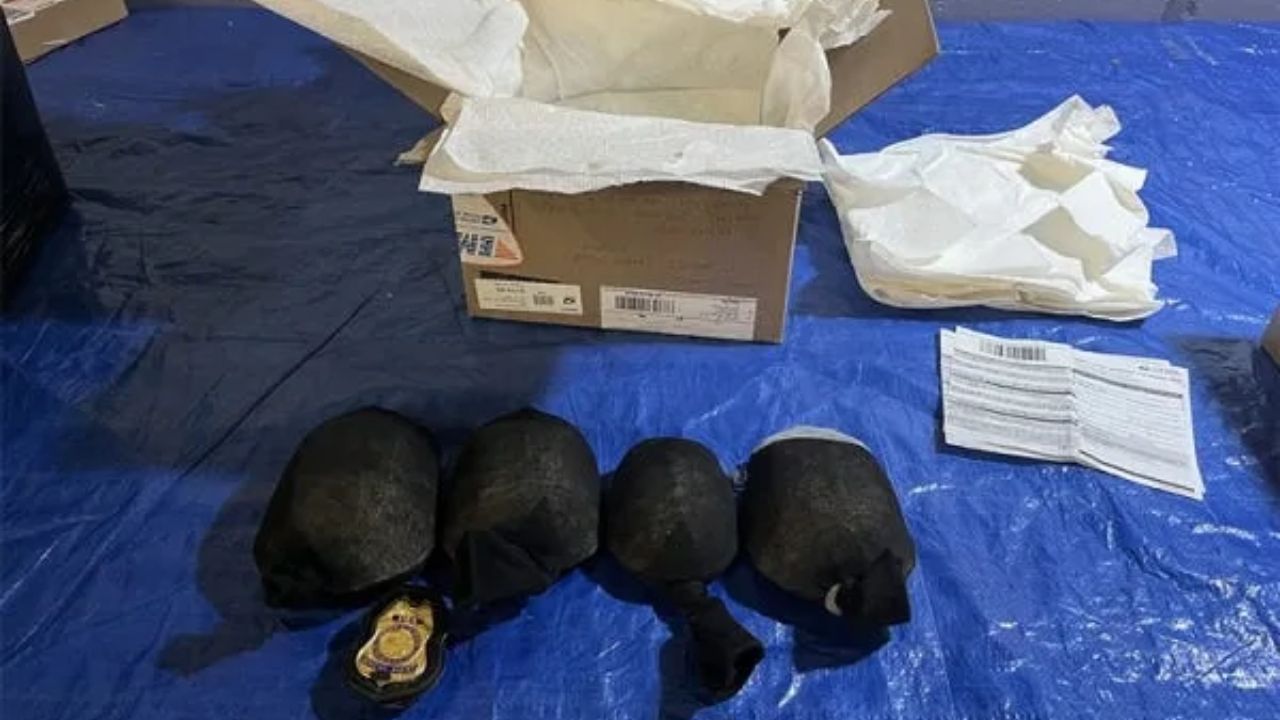
The packages were deceptively labeled as plastic animal toys, but inside authorities discovered approximately 850 live turtles, many of them bound and taped inside socks tied in tight knots. Investigators estimated the total black-market value of the turtles at about $1.4 million.
The shipments were intercepted by officers working with U.S. Customs and Border Protection and the U.S. Fish and Wildlife Service, officials said.
Highly prized turtles targeted by smugglers
According to federal court documents, most of the animals seized were eastern box turtles and three-toed box turtles, species native to the United States and protected under federal law.
The U.S. Department of Justice said these turtles are highly sought after by exotic pet collectors, particularly in China and Hong Kong, due to their vibrant markings and rarity.
“Turtle and reptile enthusiasts collect North American species of box turtles due to their handsome appearance and the wide variety of unique color variations,” wrote Ryan Bessey, a special agent with the U.S. Fish and Wildlife Service. “In fact, no two box turtles have the same markings.”
Officials say that demand from overseas collectors has fueled an underground trade that continues to threaten wild populations across North America.
Rare species ‘being collected to extinction’
Investigators also intercepted shipments containing Cora mud turtles, a rare and recently discovered species native to western Mexico. Wildlife experts say the species has become a prime target for smugglers due to its novelty and scarcity.
The seized Cora mud turtles were transferred to the Buffalo Zoo, which established an “assurance colony” to safeguard the species should wild populations decline further.
“It is sadly a case of a newly described species being collected to extinction,” the zoo said in a statement.
Conservationists warn that removing animals from the wild at this scale can have irreversible ecological consequences, particularly for slow-breeding reptiles.
Other protected animals found in shipments
Authorities said Lin’s smuggling operation extended beyond turtles. Additional intercepted packages contained alligator lizards, green tree vipers, and palm pit vipers, some of which are venomous.
Many of these species are protected under the Convention on International Trade in Endangered Species of Wild Fauna and Flora (CITES), an international agreement designed to prevent overexploitation of wildlife through global trade.
Exporting these animals without proper permits is a serious federal offense, prosecutors said.
Operation Terrapene and multi-agency investigation
Lin’s case was part of Operation Terrapene, a long-running initiative by the U.S. Fish and Wildlife Service aimed at identifying turtle smugglers and dismantling trafficking networks operating across state and international borders.
The investigation involved cooperation with several agencies, including:
- U.S. Postal Inspection Service
- Homeland Security Investigations
- U.S. Customs and Border Protection
Officials say the coordinated effort underscores the complexity of wildlife trafficking cases, which often rely on international shipping routes and false documentation.
Why wildlife trafficking cases matter
Federal authorities emphasized that wildlife trafficking is not a victimless crime. Beyond animal suffering, the trade can spread disease, undermine conservation efforts, and generate profits for organized criminal networks.
Smuggled animals often endure inhumane transport conditions, leading to high mortality rates before they ever reach buyers. Those that survive may never be returned safely to the wild.
Officials say sentencing in cases like Lin’s sends a message that illegal wildlife trade will be prosecuted aggressively.
What happens next
All animals seized during the investigation remain under federal control, with some placed in conservation programs or accredited zoological facilities. Authorities continue to monitor international shipping routes for similar smuggling attempts.
Prosecutors said investigations tied to Operation Terrapene are ongoing and additional charges in related cases are possible.
Do you think penalties for wildlife trafficking are strong enough to deter smugglers, or should they be tougher? Share your thoughts in the comments and join the discussion.