Most people who visit Clearwater know about the beach, the aquarium, and the sunsets at Pier 60. Very few know there’s a working airport sitting a few miles inland — one that’s been part of the city’s fabric since 1939.
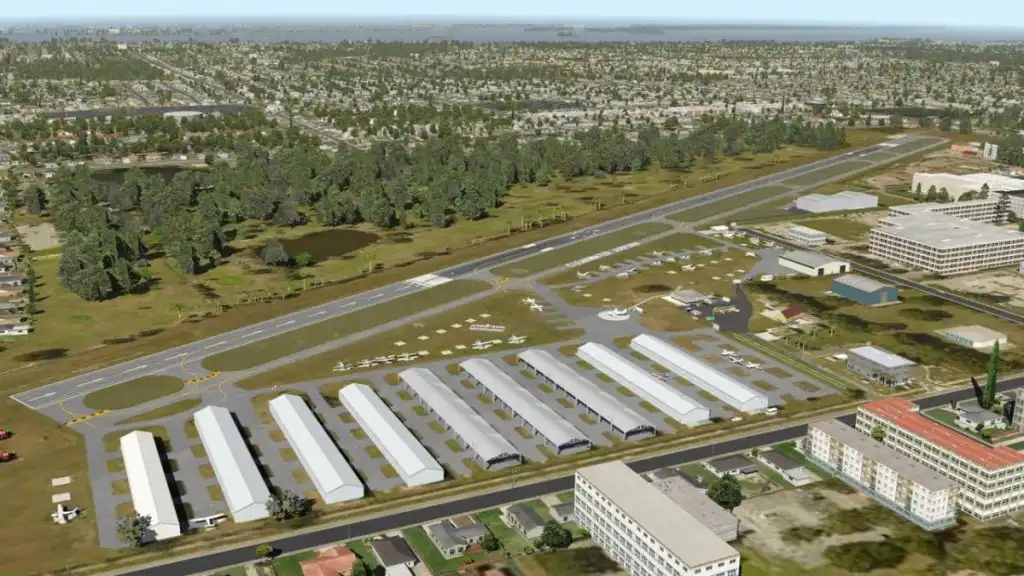
Clearwater Airpark — now officially known as Clearwater Executive Airport — is a public-use general aviation airport at 1000 N Hercules Ave in Clearwater, Florida. It’s not a commercial airline hub. No TSA lines. No departure gates. What it is, is the kind of airport that a surprisingly large portion of the population uses regularly: small aircraft, flight training, corporate props, aerial photography, and private pilots who’d rather land close to Clearwater than deal with St. Pete-Clearwater International’s procedures.
As of 2026, the airport is also mid-way through the most significant physical transformation in its history — a $13.7 million redevelopment that will replace decades-old temporary facilities with a purpose-built terminal by 2027. If you’ve been to Clearwater Airpark recently and found double-wide trailers doing duty as the airport office, that’s the thing being replaced.
Whether you’re a pilot researching the field, a Clearwater local curious about that airport you drive past on Hercules Avenue, or someone considering flight training in the area — here’s what you need to know.
Clearwater Airpark — Quick Facts at a Glance
Official Name: Clearwater Executive Airport (renamed March 31, 2025)
Former Name: Clearwater Airpark
ICAO / FAA ID: KCLW
Address: 1000 N Hercules Ave, Clearwater, FL 33765
Phone (Airport): (727) 325-5957
Phone (FBO): (727) 443-3433
Website: clearwaterexec.com
Managed by: FlyUSA Inc. on behalf of the City of Clearwater
Runway: 16/34 — single asphalt runway, 4,108 ft × 75 ft
Operating Hours: Daily 7:00 AM – 11:00 PM
CTAF/UNICOM: 123.000
Elevation: 71 feet above sea level
Based Aircraft: Approximately 125
Annual Operations: Approx. 50,000
Opened: April 1939
A Brief History of Clearwater Airpark
The land that Clearwater Airpark sits on has a longer story than most people expect from a regional general aviation field.
The airport’s origins trace back to the Fugazzi family, who owned the historic Picta Sabatia estate in Clearwater. Between 1934 and 1936, the family donated portions of this land to the City of Clearwater. The airpark officially opened in April 1939 as a grass airstrip, initially serving transient aircraft passing through the Tampa Bay area.
Like most civilian airfields of that era, it closed during World War II and reopened in 1945 as aviation activity picked back up across the country. In 1954, a formal agreement between the City of Clearwater and the Clearwater Flying Company, Inc. locked in the airport’s role as an officially city-sanctioned aviation facility — a status it has held continuously since.
For most of its operating life, the airport was known simply as Clearwater Airpark. That name stuck for decades. In March 2025, the Clearwater City Council voted to rename it Clearwater Executive Airport — a change intended to better reflect its current role serving corporate and business aviation, not just small recreational aircraft.
One detail worth knowing: The airport sits at an elevation of 71 feet above sea level. That makes it the only airport in Pinellas County not located in a flood zone. For an airport in a coastal Florida county, that’s not a trivial distinction — it affects operational reliability during and after major storms in ways that lower-elevation facilities don’t have to think about.
Airport Facilities & Operations
The Runway
The airport operates a single asphalt runway, designated 16/34. It measures 4,108 feet long by 75 feet wide. For reference, that’s enough for most single-engine and light twin-engine piston aircraft, many turboprops, and smaller business jets — the kind of traffic a general aviation airport at this scale typically sees.
Operating hours are 7:00 AM to 11:00 PM daily. The airport is not staffed 24 hours, so night operations outside of those hours are not standard.
Noise abatement: Runway 34 has specific departure procedures in place. Departing aircraft are requested to turn to a heading of 020 as soon as practical after takeoff. Touch-and-go landings are prohibited at this airport — a restriction aimed at managing noise impact on surrounding Clearwater neighborhoods.
Hangars and Aircraft Storage
The airport offers a range of aircraft storage options for based aircraft:
- Approximately 70 T-hangars
- 30 covered shade hangars
- Two corporate (multi-airplane) hangars
- On-field maintenance facility
Approximately 125 aircraft are currently based at the field, making it a genuinely active general aviation community rather than a quiet strip with a few planes. Annual operations run around 50,000 — takeoffs and landings combined.
FBO: FlyUSA Inc.
FlyUSA Inc. is the Fixed Base Operator (FBO) managing operations at Clearwater Executive Airport on behalf of the city. Their services include:
- Aircraft fueling (100LL and Jet-A)
- Aircraft sales and brokerage
- Flight instruction and training
- Aerial sightseeing
- Aerial photography services
- Ground handling and pilot services
The 2026 Redevelopment: What’s Being Built
If you visit Clearwater Executive Airport in 2026, you’ll find it mid-construction. In July 2026, the City of Clearwater and FlyUSA broke ground on a $13.7 million terminal replacement project — one of the most significant infrastructure investments the airport has seen since it opened in 1939.
The project is replacing what the airport has been operating out of for over two decades: temporary double-wide trailers that have served as the airport office since 2004. It’s the kind of setup that works until it really doesn’t, and the city made the decision to do something permanent.
What the New Terminal Will Include
- 18,000 square feet across two stories
- A flight school with a full flight simulator
- A dedicated pilot lounge for flight planning and briefing
- Corporate offices and tenant space
- FlyUSA’s new corporate headquarters
- Expanded parking
Airfield Improvements
The terminal isn’t the only thing being upgraded. The broader redevelopment includes:
- Taxiway reconstruction and improvements
- Upgraded runway lighting
- A new rotating beacon
- A new commercial hangar
- General airfield safety upgrades
Timeline: Construction began in June 2026. Completion is expected by August 2027. The airport remains operational during construction, but pilots should check NOTAMs for current taxiway configurations and any temporary closures affecting specific areas of the field.
Flight Training at Clearwater Airpark / Clearwater Executive Airport
The airport has supported flight instruction since its early years and continues to do so today. FlyUSA provides flight instruction as part of its FBO services, and the incoming terminal — scheduled for completion in 2027 — will include a dedicated flight school space and a flight simulator, which will significantly expand training capacity.
For anyone considering flight training in the Tampa Bay area, Clearwater Executive Airport is worth evaluating alongside the larger options at St. Pete-Clearwater International (PIE) and Tampa International (TPA). The benefits of a smaller general aviation field for training are real: less traffic, shorter wait times for the pattern, a more approachable environment for early student pilots, and instructors who know the local airspace well.
The Clearwater area airspace is worth understanding before you start training there. You’re operating close to Tampa International’s Class B airspace to the east and St. Pete-Clearwater International’s Class D to the south. Learning to navigate in and around those boundaries from day one gives student pilots solid real-world experience that carries over anywhere they fly.
For prospective students: Contact FlyUSA at (727) 443-3433 or visit clearwaterexec.com to ask about current flight training availability, rates, and aircraft. The instructor and aircraft lineup can change, so direct contact is more reliable than any third-party listing.
Clearwater Airpark vs. St. Pete-Clearwater International Airport (PIE)
These are two separate airports that occasionally get confused — understandably, since both carry the Clearwater name and both serve the same general metro area.
St. Pete-Clearwater International Airport (ICAO: KPIE) is the region’s commercial airport, handling airline traffic from carriers including Allegiant, Frontier, and others. It’s located in Pinellas Park, about 10 miles southeast of downtown Clearwater. PIE is currently undergoing its own $145 million modernization project — separate from anything happening at Clearwater Executive.
Clearwater Executive Airport (KCLW) — formerly Clearwater Airpark — is a general aviation field. No commercial airlines. No scheduled passenger service. Its traffic is private pilots, flight training, corporate turboprops, aerial photography, and similar operations. It’s smaller, quieter, and closer to central Clearwater.
Which One Are You Looking For?
- Flying commercially (buying tickets, checking bags): Use PIE (St. Pete-Clearwater International). It’s the commercial airline airport.
- Flying private, training, or operating a general aviation aircraft: Use KCLW (Clearwater Executive / Clearwater Airpark). It’s the GA field.
- Flying a major airline and need the biggest hub in the metro: Use TPA (Tampa International) — larger, more connections, also nearby.
Why Clearwater Airpark Matters to the Local Community
General aviation airports don’t always get credit for what they actually do. The visible part — small planes, flight training, the occasional corporate turboprop — is only part of the picture.
Clearwater Executive Airport also supports emergency response operations. Being the only Pinellas County airport not in a flood zone is a practical advantage when a hurricane hits — it’s the field that can potentially remain operational when lower-elevation airports are compromised by flooding. Emergency medical flights, disaster response, and aerial logistics all benefit from a field that stays above water.
The airport generates economic activity through based aircraft owners, flight training students, fuel purchases, maintenance operations, and businesses that use general aviation regularly. City officials have consistently described it as a critical transportation asset — not just a place for recreational pilots to park their planes.
The $13.7 million investment in a new terminal reflects a real commitment to the airport’s role in Clearwater’s future. A city that was genuinely indifferent about its general aviation airport wouldn’t spend that kind of money on a permanent terminal. The renaming to Clearwater Executive Airport is part of the same message: this is a facility the city is investing in, not running down.
Visiting or Flying Into Clearwater Executive Airport
For Pilots Flying In
- ICAO identifier: KCLW — Clearwater Executive Airport
- CTAF/UNICOM: 123.000
- Operating hours: Daily 7:00 AM – 11:00 PM
- Runway: Single runway 16/34, 4,108 ft × 75 ft, asphalt
- Noise abatement: Runway 34 — turn to heading 020 as soon as practical after departure. Touch-and-go landings prohibited.
- Weather: Check aviationweather.gov or your preferred weather service. Field elevation 71 MSL.
- NOTAMs: Always check before arriving — 2026 construction affects some ground areas
- FBO contact: (727) 443-3433 for fuel, services, and current field information
For Non-Pilots / Visitors
Clearwater Executive Airport isn’t a typical tourist attraction. You can’t board a commercial flight here. But if you’re interested in aviation or looking for something outside the standard Clearwater Beach itinerary, there are a few things worth knowing.
FlyUSA offers aerial sightseeing services. Flying over Clearwater Beach and the Gulf Coast from a small aircraft is a legitimate way to see the area from a perspective most visitors never get. The Gulf water color, the barrier islands, and the layout of the coast look completely different from 1,500 feet. It’s the kind of experience that requires a specific conversation with the FBO about what’s currently available.
If you’ve ever had a passing interest in learning to fly, a discovery flight — an introductory lesson with a certified instructor where you actually take the controls — can often be arranged through the flight training program. It’s a 30 to 60 minute experience that’s much more accessible than most people assume.
✈️ For Visitors: Call FlyUSA at (727) 443-3433 before visiting to confirm what aerial experiences are available during the construction period. Not all services that were available pre-2026 may be running in the same format mid-construction.
Frequently Asked Questions
What is Clearwater Airpark?
Clearwater Airpark is the former name of Clearwater Executive Airport (KCLW), a public-use general aviation airport located at 1000 N Hercules Ave in Clearwater, Florida. It was officially renamed Clearwater Executive Airport on March 31, 2025. The airport has operated since April 1939 and is managed by FlyUSA Inc. on behalf of the City of Clearwater.
Is Clearwater Airpark the same as the Clearwater airport?
It depends on what you mean by ‘the Clearwater airport.’ Clearwater Executive Airport (KCLW / formerly Clearwater Airpark) is a general aviation field for private aircraft and flight training. St. Pete-Clearwater International Airport (PIE) is the commercial airline airport serving the region. They are separate facilities in different locations. If you’re flying commercially, you want PIE. If you’re a private pilot or looking at flight training, you want KCLW.
What airlines fly into Clearwater Airpark?
No commercial airlines operate at Clearwater Executive Airport (KCLW). It is a general aviation airport handling private aircraft, flight training, corporate aviation, and aerial services. The commercial airline airport for the Clearwater area is St. Pete-Clearwater International (PIE), which serves Allegiant, Frontier, and other carriers.
What is the new terminal being built at Clearwater Executive Airport?
In July 2026, the City of Clearwater and FlyUSA broke ground on a $13.7 million redevelopment project. The centerpiece is a new 18,000-square-foot, two-story terminal building that will replace aging temporary trailers that have served as the airport office since 2004. The new terminal will include a flight school, flight simulator, pilot lounge, corporate offices, and FlyUSA’s headquarters. Completion is expected by August 2027.
Can you take flying lessons at Clearwater Airpark?
Yes. FlyUSA, the airport’s FBO, offers flight instruction as part of its services. The incoming terminal — scheduled for completion in 2027 — will include a dedicated flight school space and flight simulator. Contact FlyUSA at (727) 443-3433 for current training availability, aircraft, and rates. Note that touch-and-go landings are prohibited at the airport, which affects how landing practice is structured.
Why is Clearwater Airpark the only airport in Pinellas County not in a flood zone?
Clearwater Executive Airport sits at an elevation of 71 feet above sea level — significantly higher than most of coastal Pinellas County. That elevation places it outside flood zone designations that affect lower-lying areas. This distinction matters operationally: during and after significant storm events, the airport can remain functional when flooding compromises lower-elevation facilities. It’s part of why the city views the airport as an emergency response asset, not just a general aviation field.
What are the operating hours at Clearwater Airpark?
Clearwater Executive Airport (KCLW) is open for takeoffs and landings daily from 7:00 AM to 11:00 PM. The airport is not staffed 24 hours. For FBO services, contact FlyUSA at (727) 443-3433 or check clearwaterexec.com for current service hours.