
Last spring I watched a couple at Pier 60 argue — good-naturedly — about whether the water was turquoise, jade, or teal. The husband swore it was blue. The wife was pulling out her phone to color-match. I’d heard the same debate a dozen times at sunset happy hours, from solo travelers, from families who’d flown in expecting the postcard turquoise and got something better — emerald.
So — what color is Clearwater Beach water, really? The honest answer is emerald-green, and “emerald” is doing a lot of work in that sentence. It’s not the green of the Atlantic side of Florida, and it’s not the flat blue of the Pacific. It’s a specific shade, and once you understand what makes it, you’ll know exactly when to come, where to stand, and what to expect.
Why Clearwater’s Water Color Isn’t a Mystery
The science is straightforward — and a lot more interesting than the brochure makes it sound. Water itself is colorless in small volumes and absorbs red wavelengths as depth increases, which is why deep ocean reads blue. But Clearwater isn’t deep ocean. The West Florida Shelf off Pinellas County is one of the widest and shallowest in the U.S. — NOAA mapping programs and the USGS St. Petersburg Coastal and Marine Science Center have documented how gently the seabed shelves offshore, holding shallow depths for a long stretch before dropping off. Light reflects off the bottom before the red wavelengths get absorbed. The color you see is the color of the sand.
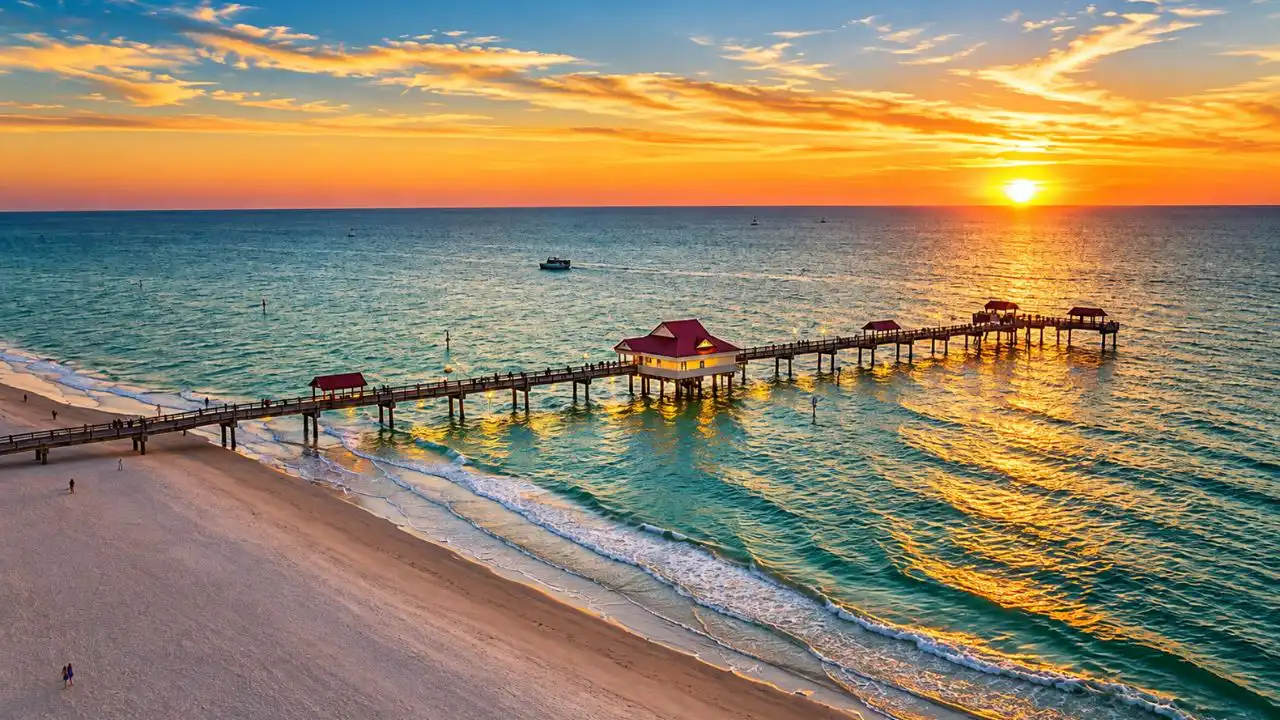
That’s the whole trick. The water isn’t blue. The water is showing you the sand.
The Three Ingredients That Make the Water Green
1. Quartz sand, not coral
Clearwater’s sand is predominantly quartz — fine, white, well-sorted silica grains that reflect light efficiently. The same white quartz sand defines the broader Florida Gulf coast beach system (where the deep coral-based whites of the Caribbean are absent) — and that geological difference is exactly what gives the water its signature look. Drive an hour south to some of the harder-hit beaches after a storm and you’ll see the difference — browner sand, muddier water, beaches that don’t show up on anyone’s “best of” list. The color of the water is downstream of the color of the sand.
2. A shallow, gradual shelf
Florida’s Gulf coast shelves gently. Compare that to the Atlantic side, where the continental shelf drops fast — water reads deep blue within a few hundred feet. On the Gulf, the light has time to bounce. It’s also why Clearwater can read greener and Siesta Key can read a slightly bluer emerald, depending on which stretch you’re standing on. The West Florida Shelf’s broad, shallow profile is consistent across the federal scientific record.
3. Sun angle and time of day
This is the part nobody talks about. The “emerald” effect is strongest mid-morning to early afternoon, when the sun is high and the light path through the water is shortest. At sunset, the water goes gray-violet. At dawn, it goes silver. If you’ve ever shown up at 6 p.m. and thought the beach “didn’t look like the photos,” that’s why. The photos were shot at 11 a.m.
When to Come for the Best Water Color
The seasonality of water color is the part you can actually defend with published rankings. Clearwater Beach was ranked the #1 beach in the United States and #4 in the world in TripAdvisor‘s 2024 Travelers’ Choice Awards. The same stretch of Pinellas sand has made Dr. Beach (Stephen Leatherman)’s annual Top 10 Beaches list in multiple recent years. Neither organization hands out those rankings for a beach with chronically brown water.
The clean-water window is roughly April through July. That’s when the Gulf is calmest, the algae is least active, and visibility is highest. From late August through October, red tide events and storm-driven runoff can turn the water green-brown or tea-colored. The Florida Fish and Wildlife Conservation Commission (FWC) tracks Karenia brevis blooms in near real-time and publishes a status map updated multiple times per week. Check the FWC map the week before you fly — it can save a trip you’re not going to enjoy.
The simple pattern: flights in March, hotel in May, on-the-ground in April. Anything later than mid-August is a gamble.
What This Means for Your Trip
- Show up between 11 a.m. and 2 p.m. That’s when the water reads truest. If you’re planning a wedding, an anniversary shoot, or a milestone trip, plan the photo sessions around this window.
- Stay walking distance to the beach. If the water color matters to you (and it should — it’s why you came), the hotel matters more than the room rate. You’re paying for proximity to that emerald.
- Check the FWC map before you book. Pinellas County publishes localized red tide advisories (Pinellas County — Red Tide Information). NOAA’s Gulf Coast HAB Forecast is the federal scientific overlay (NOAA NCCOS — Gulf Coast HAB Forecast). Two minutes of research can save you a wasted trip.
- Pack for the morning, not the sunset. Even if you’re not a morning person, the 11 a.m. hour is when the water is at its best. Sunset is gorgeous, but the water colors are muted.
FAQ
Is the water at Clearwater Beach actually green?
Yes — emerald-green, not turquoise or true blue. The green comes from white quartz sand at the bottom reflecting light through shallow Gulf water on the West Florida Shelf. It’s a specific, measurable reason, not a marketing line.
Why is Clearwater’s water clearer than other Florida beaches?
A combination of fine quartz sand, lower algae activity in spring and early summer, and a very gradual continental shelf that lets light reflect off the bottom before it gets absorbed. Atlantic-side beaches drop off faster and read bluer.
What month is the water clearest in Clearwater?
April through June is the most reliable window for the emerald-green color. Late summer can see red tide (Karenia brevis blooms) and storm runoff that turns the water greenish-brown. November is often a quieter month with good clarity.
Is Clearwater Beach water safe to swim in?
Generally yes, with the same coastal precautions as any Gulf beach. The main variable is red tide — the FWC publishes current bloom status on its Red Tide Current Status page, and Pinellas County posts local advisories. Red tide can cause respiratory irritation and dead fish at the shoreline, and the water color changes accordingly.
Can you swim year-round at Clearwater Beach?
Water temperature runs from about 62°F in January to 86°F in August. Most visitors swim March through October. Year-round swimmers are usually locals and the truly committed.
Conclusion
The color of Clearwater Beach water isn’t a mystery — it’s a recipe. White quartz sand, a shallow shelf, the right sun angle, and a seasonal window that runs roughly April through July. If you can time the trip right and show up at the right hour of the day, you’ll see the same green that put the beach on every major best-of list.
Have you been to Clearwater? What time of year did you see the water — and what color did it look like to you?